
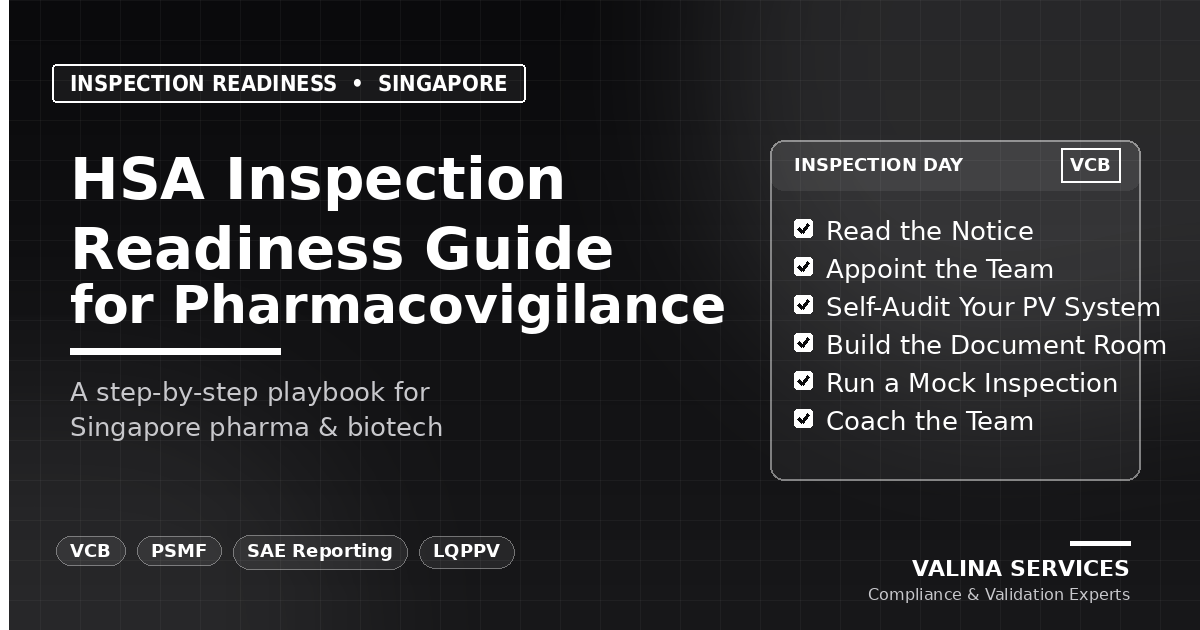
How to Prepare for an HSA Pharmacovigilance Inspection: A Step-by-Step Guide for Singapore Companies
May 04, 2026
If youve just received notice of an HSA pharmacovigilance inspection, the first thing to know is this: youre not in trouble yet, but how you spend the next few weeks will decide whether you stay out of it.
The Health Sciences Authoritys Vigilance and Compliance Branch (VCB) doesnt inspect on a whim. They inspect because you hold a registration, because something in the data caught their eye, or because its simply your turn in the cycle. Whatever the reason, the inspection is happening, and the only question now is how ready youll be when it does.
At Valina Services, weve walked many APAC pharma, biotech, and medical device companies through HSA inspections, both planned ones and the slightly more sweaty unannounced kind. The good news? HSA inspectors are professional, fair, and predictable. The bad news? They notice everything, and "well fix that later" doesnt fly when an inspector is sitting across from you.
So heres the practical, step-by-step guide we use with our own clients. No fluff, no jargon, no boilerplate. Just what you need to do, in the order you should do it.
First, the Quick Context: Why HSA Inspects, and What Theyre Looking For
HSAs pharmacovigilance oversight in Singapore sits under the Vigilance and Compliance Branch (VCB). Their job is to make sure that any company holding a Singapore product registration is actually doing what they promised in their PV system, not just on paper, but in practice.
The current framework lives in HSAs "Guidance for Industry: Post-Marketing Vigilance Requirements for Therapeutic Products and CTGTP" (Version 6, effective April 2026), and it covers the full lifecycle: adverse event reporting, periodic safety reports, risk management plans, safety notifications, and the systems and people behind them.
At a high level, HSA inspectors want to confirm five things:
1. You have a documented PV system, and it actually works.
2. Serious adverse events are reported within the 15 calendar day timeline.
3. Records are complete, traceable, and retained for at least 2 years after product expiry.
4. International regulatory actions affecting your products are notified to HSA promptly, with a local impact assessment.
5. The people responsible for PV in Singapore are real, qualified, and reachable.
Thats the lens. Now lets get you ready.
Step 1: Read the Notification Letter Properly (Yes, All of It)
When the inspection notice arrives, it will tell you the scope, the dates, whos coming, and what they expect to see. Read every line. Twice.
Specifically, identify:
• The inspection scope (full PV system audit vs. a focused review of specific products or processes)
• The timeframe under review (usually the past 2 to 3 years)
• Any specific documents theyve asked for in advance
• The logistics (on-site, hybrid, remote, and the working hours expected)
If anything is unclear, contact HSA and ask. Inspectors prefer companies that engage early over companies that go quiet and then panic.
Step 2: Appoint Your Inspection Team Immediately
Dont wait until the week before. The moment you confirm the inspection, name three people:
• The Inspection Lead. Usually your Local Qualified Person for Pharmacovigilance (LQPPV) or PV Manager. Single point of contact, owns the response.
• The Document Coordinator. Owns the document room (physical or virtual), the file index, and the document control trail. This is the unsung hero of every successful inspection.
• The Subject Matter Experts. People who can speak to specific processes: case processing, signal detection, RMP execution, literature monitoring, vendor oversight. They dont need to be in the room all day, but they need to be reachable in minutes.
Write down whos responsible for what. Inspectors will ask, and "well figure it out" is not an answer that builds confidence.
Step 3: Do an Honest Self-Audit (The Sooner, The Better)
This is the single highest-value step in inspection prep, and the one most often skipped. Before HSA finds your gaps, find them yourself.
Run a focused internal audit against these areas:
Case Processing
• Are SAEs reported to HSA within 15 calendar days, every time?
• Is causality assessment documented for each case?
• Are follow-up reports submitted within 15 days of new information?
• Are case records complete, with reporter details, patient details, product details, and event narrative?
Periodic Safety Reports
• Have all required PSURs or PBRERs been submitted on time?
• Is there a current Risk Management Plan (RMP) for each product that requires one, including the Singapore-Specific Annex where applicable?
Signal Detection and Risk Management
• Is there documented evidence of routine signal detection activities?
• Have any signals identified been actioned, documented, and communicated?
• For products with additional risk minimisation measures (e.g. educational materials, controlled access programmes), is implementation documented?
Safety Notifications to HSA
• Have international regulatory actions (FDA, EMA, MHRA, Health Canada, Swissmedic, TGA, PMDA) affecting your Singapore products been notified to HSA?
• Was a local impact assessment included?
Records and Documentation
• Are all PV records retained for at least 2 years after product expiry?
• Are records traceable, legible, and retrievable on demand?
• Is your Pharmacovigilance System Master File (PSMF) up to date?
People and Training
• Is the LQPPV named, qualified, and accessible?
• Are PV roles documented in writing?
• Is there a training matrix, and have all PV staff completed required training with documented evidence?
Every "no" or "Im not sure" is a gap. Log it. Fix it. Document the fix.
Step 4: Get Your Document Room Ready
Whether the inspection is on-site or remote, you need a well-organised document set ready to share. Inspectors will ask for documents on the spot, and "give us a few days" is not an answer.
Build an indexed document room (a structured shared folder works fine) containing:
• PV system documentation: PSMF, organisation chart, role descriptions, contact list
• SOPs: all PV-relevant procedures, with version history and training records
• Case files: representative sample of ICSRs from the inspection period, including initial reports, follow-ups, and submissions
• Periodic reports: PSURs, PBRERs, RMPs (including the Singapore Annex), risk-benefit assessments
• Signal management records: signal detection logs, signal evaluations, actions taken
• Vendor and partnership agreements: safety data exchange agreements (SDEAs) with licensors, distributors, CROs
• Training records: training matrix, individual records, evidence of competency
• Audit and CAPA records: previous internal audits, any CAPAs from prior inspections, and evidence of closure
• Regulatory correspondence: any prior queries from HSA and the responses
Tip: number every document. Maintain an index. Make sure the version on the shelf matches the version in the system. Inspectors love finding mismatches.
Step 5: Run a Mock Inspection
A mock inspection is the closest thing to an insurance policy youll get. We strongly recommend this two to four weeks before the real thing.
The best mock inspections are run by someone outside your day-to-day PV team, ideally an external consultant who has actually sat through HSA inspections. Theyll:
• Ask the questions inspectors ask
• Request documents the way inspectors request them
• Pressure-test the teams ability to answer clearly and concisely
• Find the awkward gaps youve stopped noticing because you walk past them every day
What feels uncomfortable in a mock saves you in the real one.
Step 6: Coach Your Team on Inspection Behaviour
This sounds soft, but it matters more than people realise. The most common reason inspections go badly isnt because the system was broken. Its because someone in the room talked too much, guessed at an answer, or contradicted a colleague.
Brief your team on the basics:
• Answer the question that was asked. No more, no less.
• If you dont know, say so. "Ill need to check and come back to you" is a perfectly acceptable answer. Guessing isnt.
• Dont speculate, dont apologise, dont volunteer extra information.
• One voice at a time. Designate who speaks to which topic. Dont let colleagues talk over each other.
• Stay calm. Inspectors arent trying to trip you up. Theyre trying to confirm you do what you said you do.
For LQPPVs especially: be ready to walk through your PV system end-to-end, in your own words, without reading from a document. If you cant, thats a sign you need to know your own system better.
Step 7: During the Inspection, Manage the Day
A few practical things that make the day run smoothly:
• Open with a brief welcome and an agenda. Dont drag it out.
• Take notes throughout. Have a dedicated note-taker logging every question asked, every document requested, and every commitment made.
• Hold a daily wrap-up. At the end of each day, review what was covered, whats still outstanding, and whats coming tomorrow.
• Dont argue. If an inspector raises a concern, listen. Acknowledge. Youll have time to respond formally later.
• Manage document requests in real time. Use a request log, and aim to deliver requested documents within the same day.
If something genuinely cant be produced quickly, say so honestly, give a realistic timeline, and meet it.
Step 8: Handle the Findings Professionally
At the close of the inspection, HSA will summarise their observations. These typically fall into three buckets: critical, major, and minor findings.
Your job is not to argue them down. Your job is to:
- Listen carefully and clarify any findings you dont understand.
- Acknowledge the findings without admitting more than was raised.
- Commit to a written response and corrective action plan within the timeframe HSA specifies.
- Deliver the plan on time, with realistic, evidence-backed actions.
A well-written CAPA response with clear ownership, timelines, and evidence of closure does more to rebuild regulator confidence than any amount of explanation in the closing meeting.
The Most Common Reasons APAC Companies Fail HSA Inspections
After years of doing this work, the same handful of issues account for most negative findings:
• Late SAE submissions because the case processing workflow has bottlenecks nobody fixed.
• Missing or outdated PSMF that no longer reflects how the organisation actually works.
• No documented signal detection even though "we discuss safety in our meetings" (thats not signal detection, thats a chat).
• Vendor oversight gaps where the SDEA exists but no one has actually checked the vendor is complying with it.
• Training records that dont match the people on the team (someone left, someone joined, nobody updated the matrix).
• An LQPPV who cant explain their own system because they inherited it and never properly reviewed it.
All of these are fixable. None of them are fixable in the week before the inspection.
How Valina Helps Companies Get Inspection-Ready
This is the work we do every week. Valina helps APAC pharma, biotech, and medical device companies in three ways:
1. Pre-Inspection Readiness Assessments. We come in, look at your PV system the way an HSA inspector would, and give you a clear gap list with priorities. No drama, no upselling, just an honest read of where you stand.
2. Mock Inspections. We run a realistic mock inspection, including document requests, interviews, and a closing meeting with findings, so your team is calm and capable when the real one happens.
3. Compliance as a Service (CaaS) for Pharmacovigilance. For companies that dont have the bandwidth to maintain a full PV operation, we run it for you using the AB Cube SafetyEasy® platform as our engine. Case processing, regulatory reporting, signal detection, PSMF maintenance, the lot, delivered as a managed service. So when the next inspection comes, youre already ready.
Inspections dont have to be stressful. They become stressful when companies wait until the notice lands to take their PV system seriously.
Final Thoughts
An HSA pharmacovigilance inspection is, in the end, a test of whether you do what you say you do. If your PV system runs well day-to-day, the inspection is largely a formality. If it doesnt, no amount of pre-inspection scrambling will hide that for long.
The companies that handle inspections well are the ones that treat every day like a possible inspection day. Not paranoid, just disciplined.
If youve just received an inspection notice, or youd rather not wait for one to find out where you stand, thats exactly the conversation we like having. Get in touch with us, and we can help you out.
This blog provides general information and should not be considered regulatory advice. Always consult qualified professionals and refer to the latest HSA guidance regarding your specific compliance requirements.
Posted by Dr Suhanya Parthasarathy, PhD | Valina Services Pte Ltd