
APAC Pharmacovigilance in 2026: Why Speed and Compliance Are Finally on the Same Team
May 12, 2026
Three years ago, a clinical-stage biotech in Singapore asked us how quickly they could stand up a compliant safety database. The honest answer at the time was 'four to six months. Six months of meetings. Mountains of validation paperwork. Customising every workflow from scratch. By the time the system was actually ready, the trial was already enrolling, and the safety team was already three steps behind.
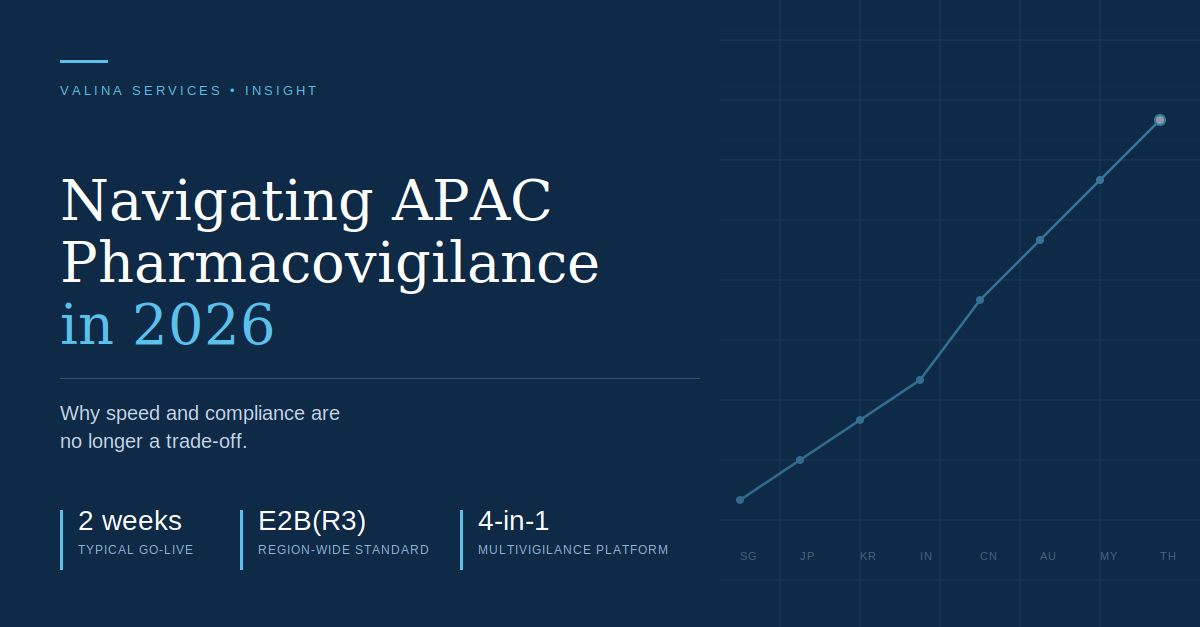
Today, it's two weeks
So what actually changed?
Three big shifts have rewritten the rulebook for safety-data
operations across APAC, and they're worth paying attention to.
First, regulators finally caught up to the cloud. ICH
E2B(R3) is now the global standard for adverse event reporting, with China
formally accepting it in 2023. Japan, Singapore, Korea, and Australia are all
aligned. A modern PV stack now needs to speak one electronic language across an
entire region, and the agencies on the receiving end expect exactly that.
Second, the build-vs-buy economics flipped. On-premises safety databases were the default, with custom development to match every
sponsor's workflow. That model assumes IT validation cycles are cheap and
engineering time is free. Spoiler: neither is true anymore. Pre-validated SaaS
platforms, already aligned to 21 CFR Part 11, GAMP 5, and E2B(R3),
let teams go live in weeks rather than quarters.
Third, multivigilance became the norm. Pharma isn't the
only regulated category anymore. Medical devices need materiovigilance.
Cosmetics need cosmetovigilance. Nutraceuticals need nutrivigilance. Companies
running combination products or diversified portfolios now want a single
platform that handles every vigilance type, with one audit trail.
What this means for APAC teams
Here's the plain truth: the slowest path is now the
riskiest one. Custom-building a safety system in 2026 doesn't just cost
more; it locks teams into an architecture that has to be re-validated every
time a regulator updates a guideline. And in APAC, regulators are moving fast.
At Valina Services, we work with life sciences companies and CROs across Singapore, Japan, Korea, India, and Greater China.
The teams getting it right have moved decisively in the other direction. Three
patterns stand out.
Pattern 1: Pre-validated by default
Why spec a system and then validate it when you can pick a
platform that arrives pre-validated and only validate the configuration?
This is exactly what we see with AB Cubes SafetyEasy®
Suite. Typical go-live? Two weeks. Not two quarters. Because the
underlying validation work is already done.
Pattern 2: One database, every vigilance
Companies are consolidating PV, device, cosmeto, and nutri
vigilance onto a single platform. The compliance benefit is obvious: one audit
trail, one set of access controls, one place to defend in an inspection.
But the operational benefit is even bigger, signals that
span product categories actually become visible, instead of being trapped in
separate silos.
Pattern 3: Validation as a service, not a project
The biggest mistake we still see? Treating GxP IT validation
as a one-time project.
Regulators don't. Every system upgrade, every infrastructure
change, every new MedDRA version triggers validation impact. Teams that run
validation as a continuous service, with documented change control and
lightweight re-validation playbooks, pass audits faster and lose a lot less
sleep.
Evaluating a PV platform this year? Ask these three questions.
If your team is reviewing PV infrastructure in 2026, three
questions narrow the field very quickly.
•
Is the platform pre-validated to GAMP 5 and 21 CFR
Part 11, with documentation you can hand to an inspector tomorrow?
•
Does it cover every vigilance type your
portfolio touches, or will you be running two systems in three years?
•
Who handles the APAC-specific configuration:
local-language reporting, country-specific E2B fields, agency gateway
integrations?
A vendor that aces the first two but waves off the third is
selling you a platform, not a solution. And configuration work is
exactly where compliance is won or lost.
Where Valina fits in
We sit right at the intersection of those three patterns. As
the APAC partner for AB Cubes SafetyEasy® Suite, we deploy the
pre-validated platform, and we handle the local configuration, GxP IT
validation, QMS alignment, and ongoing audit support that turns it into a
working safety operation.
For European clients expanding into APAC, we shorten the regional
setup from a project into a programme. For APAC-headquartered companies going
global, we make sure the system that handles your local market is already ready
for the next one.
The bottom line
The trade-off between speed and compliance? It was always
artificial.
In 2026, the teams that recognise this are the ones shipping
faster, passing audits cleaner, and spending their energy on the medicine, not
the database.
If safety-data operations are on your roadmap this year, let's
talk. That's what we're here for.
This blog provides
general information and should not be considered regulatory advice. Always
consult qualified professionals regarding your specific compliance
requirements.
Posted on May 12, 2026, | By Dr
Suhanya Parthasarathy. PhD