
AI Inside Your QMS: Where It Genuinely Helps, and Where It Quietly Bites
Jun 10, 2026
Every quality team knows the feeling. A deviation gets logged, then sits. The investigation drags. The CAPA is written, reviewed, revised, and somewhere along the way the same root cause shows up again three months later in a different part of the plant. Quality work is essential, but a lot of it is slow, repetitive, and easy to fall behind on.
This is exactly the gap AI is now being aimed at. Across pharma, biotech, and medical devices, AI is moving into the heart of the Quality Management System, into deviations, CAPA, change control, and audits, with vendors promising faster investigations, fewer repeat issues, and a lot less manual paperwork. Some of those promises are real. Some need a much closer look.
At Valina Services, we help APAC companies adopt these tools without trading speed for compliance. So heres an honest, practical look at what AI actually does inside a QMS, where the genuine value is, where the risks hide, and how to bring it in the right way.
What "AI in the QMS" Actually Means
Strip away the marketing, and AI in a quality system tends to show up in a handful of concrete places:
- Deviation triage and classification. Models that read an incoming deviation and suggest a category, severity, or priority, so the right ones get attention first.
- Root cause support. Tools that scan historical events to surface patterns a human might miss, and point investigators toward likely causes.
- CAPA drafting and recommendation. Assistants who draft investigation narratives or suggest corrective actions based on similar past events.
- Change control impact analysis. Systems that assess a proposed change against historical data and flag likely downstream impacts.
- Trend detection across quality events. Analytics that connect deviations, complaints, and OOS/OOT results to spot a recurring issue before it becomes a pattern of findings.
The common thread is that AI isnt replacing the quality professional. Its doing the reading, sorting, and first-draft work, so the human can spend their time on judgment rather than admin.
The Genuine Wins (Backed by Real Numbers)
This isnt all hype. The efficiency gains being reported in real QMS environments are substantial and worth knowing:
- AI-assisted deviation triage has been reported to speed up initial classification by roughly 15 to 30 per cent.
- AI-generated documentation drafts are cited as cutting writing time by 40 to 60 per cent.
- In manufacturing settings, AI-driven batch record review has been described as reducing review time by up to 80 per cent, with deviation closure cycles dropping from 30-plus days to under 10.
Beyond the numbers, the qualitative shift matters more. Traditional QMS work is reactive: something goes wrong, you investigate, you correct. AIs real promise is making quality proactive, using predictive models to flag recurring issues before they generate a brand-new deviation. Thats the difference between fighting fires and preventing them.
Theres even an audit angle. Regulators themselves are beginning to use AI tools to evaluate quality systems and target inspections, which means companies that adopt AI thoughtfully may be better prepared for the way oversight is heading, not just faster internally.
Where It Quietly Bites
Now the part the demos skip over. AI inside a QMS introduces risks precisely because it touches GxP-critical decisions, and those risks are easy to underestimate.
The "Helpful Draft" That Nobody Truly Reviews
When an AI drafts a deviation narrative or a CAPA in seconds, the temptation is to skim and approve. Over time, "AI wrote it, looked fine" becomes the de facto process. But the accountability still sits with your people. A plausible-sounding investigation that misses the real root cause isnt a time-saver. Its a future repeat deviation with a paper trail.
Automation Bias
The more a model is right, the more people stop checking it. Thats human nature, and its dangerous in quality. The day the model gets a classification wrong is the day nobodys looking, because its been right for months.
Black-Box Recommendations
If a tool recommends closing an investigation or approving a change, can you explain why? Regulators increasingly expect explainability, confidence levels, and clear decision thresholds. "The system suggested it" is not a defensible rationale in front of an inspector.
Validation and Data Integrity
Any AI tool touching GxP data is a computerised system under Annex 11 and 21 CFR Part 11. It needs validation against its intended use, audit trails, access controls, and electronic signature integrity, just like any other system. An unvalidated AI feature embedded in your QMS is a data integrity gap, however clever it is.
How to Adopt AI in Your QMS the Right Way
The goal isnt to avoid AI. Its to bring it in so it strengthens your quality system rather than undermining it. Heres the approach we walk clients through.
Step 1: Start Where the Risk Is Lowest
Begin with high-volume, lower-criticality tasks: drafting first-pass documentation, triaging incoming events, surfacing trends for a human to review. Prove the value and build confidence before letting AI anywhere near a release decision or an investigation conclusion.
Step 2: Define the Human Decision Point
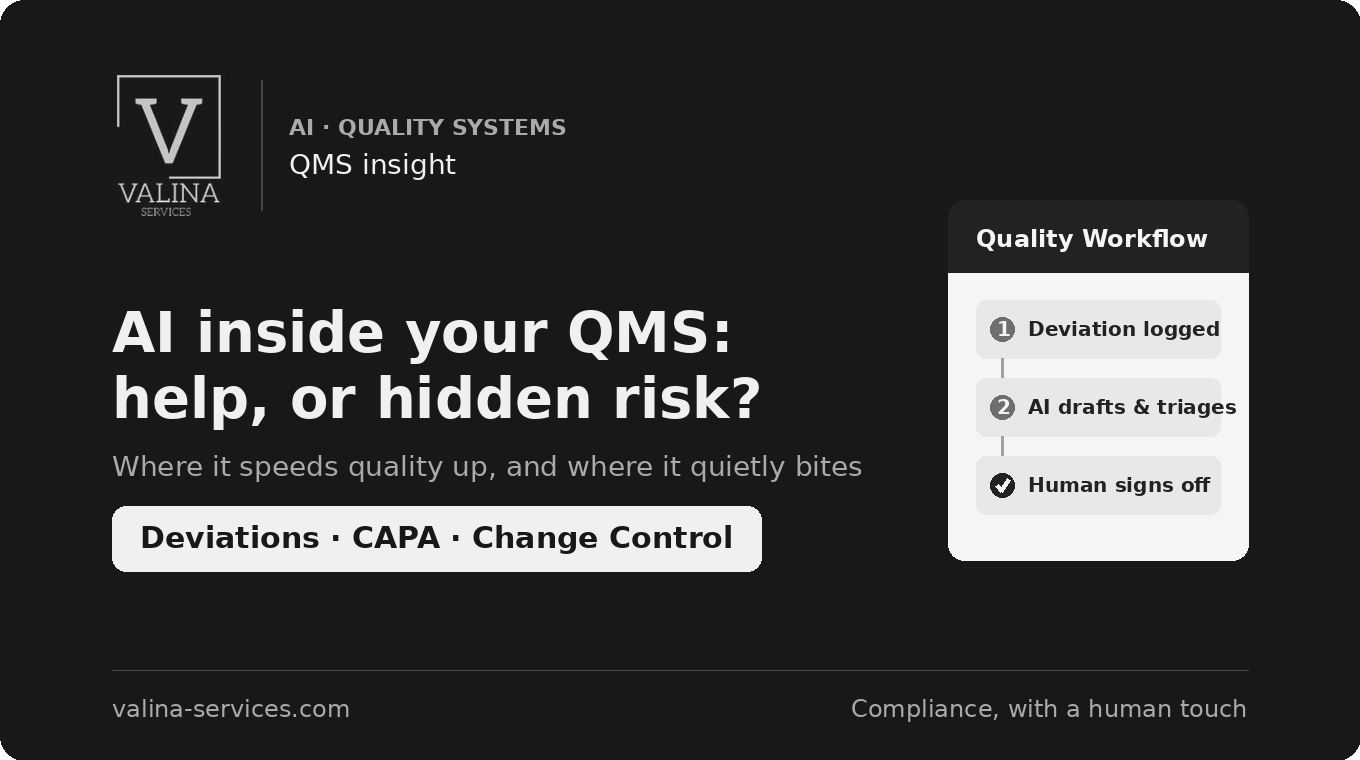
For every AI-assisted step, be explicit about who reviews the output, what theyre checking, and how that review is recorded. The AI proposes. A qualified person disposes and signs. Build that sign-off into the workflow so it cant be skipped.
Step 3: Validate It Like the GxP System It Is
Treat AI tools as computerised systems requiring validation. Define intended use, run risk-based validation, confirm audit trails and access controls, and document it. If a vendor offers pre-validated IQ/OQ/PQ packages, that helps, but the responsibility for validation in your environment is still yours.
Step 4: Demand Explainability
Favour tools that show their reasoning, confidence scores, feature attribution, and clear thresholds over black boxes that just produce an answer. When a recommendation influences a quality decision, you need to be able to justify it.
Step 5: Monitor for Drift and Over-Reliance
Set periodic reviews to confirm the model is still performing, and watch your own team for automation bias. A model that quietly degrades, or a team that quietly stops checking, are the two failure modes that turn an AI win into an AI finding.
The Bigger Picture
AI in the QMS is part of a broader shift from reactive to predictive quality, and its accelerating. The companies pulling ahead arent the ones adopting AI fastest, or the ones avoiding it entirely. Theyre the ones adopting it deliberately, capturing the genuine efficiency gains while keeping validation, explainability, and human accountability firmly in place.
Done well, AI lets your best quality people stop drowning in paperwork and start doing the high-judgment work only they can do. Done carelessly, it adds speed to processes that are quietly wrong. The difference is entirely in how you bring it in.
How Valina Helps
This is the work we do every week. If youre weighing up AI for your quality system, or youve already got AI features running and arent sure theyre properly controlled, heres how we can help:
- QMS and AI Readiness Assessment. We review where AI could deliver real value in your quality processes, and where it would introduce unacceptable risk, so you invest in the right places.
- Risk-Based Validation and Governance. We build pragmatic, GAMP 5-aligned validation and oversight for your AI-enabled QMS tools, sized to their actual criticality, so you stay compliant without drowning in documentation.
- Compliance as a Service (CaaS). For teams without the bandwidth to manage this in-house, we provide ongoing support, including the monitoring and periodic review that AI systems need across their lifecycle.
Final Thoughts
AI inside the QMS is one of the most genuinely useful applications of the technology in our industry, and one of the easiest to get subtly wrong. The efficiency gains are real. So are the risks of automation bias, black-box decisions, and unvalidated systems quietly shaping GxP outcomes.
You dont have to choose between modern and compliant. With the right structure, AI makes your quality system both faster and more defensible at the same time.
If youd like an honest read on where AI fits in your QMS, and how to adopt it without creating tomorrows findings, thats exactly the conversation we like having. Contact us for a consultation, and well help you get there.
This blog provides general information and should not be considered regulatory advice. Always consult qualified professionals and refer to the latest FDA, EMA, and HSA guidance regarding your specific compliance requirements.
Posted by Dr Suhanya Parthasarathy.PhD